Beijing Capital Airport: Once the World's Largest Airport Terminal
Beijing Capital International Airport (PEK) — Beijing, China
Published August 12, 2026
PEK
IATA code
67.4M (2024)
Passengers
3
Terminals
32 km / 20 mi
To city center
Only here
Once the largest airport terminal in the world
Terminal 3, built for the 2008 Beijing Olympics and designed by Norman Foster, was the largest single airport terminal building on Earth when it opened — nearly 1 million square meters, big enough that an internal train shuttles passengers between its far ends.
Getting there, at a glance
Beijing Airport Express
¥25
~20–30 min
Subway direct to city center
Airport shuttle bus
¥16–30
~45–60 min
Multiple routes across the city
Taxi
¥100–150
~40–60 min
Comfortable but pricier
✈️ What kind of flight are you taking?
Arrive at the airport
90 minutes
Typical security wait
20–30 min
Peak-hour wait
35–50 min
Amenities, at a glance
Wifi
Free, requires passport registration
Lounges
Air China + Priority Pass
Duty-Free
Chinese tea, silk, liquor
Dining
Beijing roast duck, regional Chinese cuisine
Book & Save
These are affiliate links — we may earn a commission if you book through them, at no extra cost to you.
Beijing Capital International Airport (IATA: PEK) is one of the busiest airports in the world and Air China’s primary hub, handling more than 55 million passengers a year. It sits about 32 km (20 mi) northeast of central Beijing.
Overview
PEK operates three terminals, with Terminal 3 standing out as one of the largest airport terminal buildings ever built — when it opened for the 2008 Beijing Olympics, it was the largest single airport terminal in the world, designed by architect Norman Foster with a dragon-inspired roofline. Beijing now also has a second major airport, Daxing (PKX), but PEK remains a massive hub, particularly for Air China and Star Alliance — official operating data put its 2024 passenger throughput at 67.37 million, up 27.4% year-on-year as international travel continued recovering.
Terminals
- Terminal 1: The airport’s original, smaller terminal, handling a limited number of domestic flights.
- Terminal 2: A mix of domestic and some international carriers.
- Terminal 3: Air China’s main hub terminal and the primary international gateway, so large that an internal shuttle train connects its far ends.
Airlines
Air China, China’s flag carrier, operates its primary hub at PEK, anchoring Terminal 3 with an extensive domestic network across the country plus international long-haul routes as a Star Alliance member. That hub concentration makes PEK one of the best-connected airports for travel to and within China, alongside Beijing’s newer Daxing airport.
How to Get There
- Beijing Airport Express: ¥25 flat fare, a dedicated subway line connecting directly to the city center (Sanyuanqiao/Dongzhimen) in about 20–30 minutes — the fastest and most predictable option.
- Airport shuttle bus: ¥16–30 depending on the route, with multiple lines covering different parts of the city, about 45–60 minutes.
- Taxi: ¥100–150 to central Beijing, about 40–60 minutes depending on traffic — comfortable but noticeably pricier than the train.
Prices above are indicative and can change — always check current fares with the Beijing Airport Express or the airport’s official transport page.
Getting Through Security and Passport Control
- Domestic flights: Security only. Typically 20–30 minutes off-peak, up to 35–50 minutes during busy periods.
- International flights: Security plus passport control. Typically 30–45 minutes off-peak, up to 55–80 minutes during peak international departure banks — security at major Chinese airports tends to be thorough, so budget generous time.
- China’s 144-hour visa-free transit policy applies at PEK for eligible nationalities — if using it, have your onward ticket and required paperwork ready, as the process is separate from standard immigration.
Parking
All three terminals have adjacent short- and long-stay car parks. Given the airport’s scale and distance from the city, most visitors rely on the Airport Express, bus, or taxi rather than driving.
Wifi
Free wifi is available throughout the airport, though registering with your passport number is typically required to connect — a standard requirement at Chinese airports.
Best Times to Arrive
- Domestic flights: 90 minutes before departure is typically enough.
- International flights: Arrive 3 hours ahead — security and passport control processing can take longer than at other major hubs, especially during peak periods.
- Given Terminal 3’s sheer size, budget real time to reach your gate after security, especially if you’re departing from one of the terminal’s far ends — the internal shuttle train ride itself takes several minutes.
Where to Eat
PEK has an excellent selection of Beijing roast duck and regional Chinese cuisine alongside international chains, spread across all three terminals — Terminal 3 in particular has a wide range given its size and status as the main international gateway.
Lounges
- Air China lounges are extensive across Terminal 3, reflecting its role as the airline’s main hub, accessible with eligible tickets, elite status, or membership.
- Several Priority Pass-affiliated lounges are also available.
Duty-Free Shopping
PEK’s duty-free zone includes Chinese specialties — tea, silk products, and Chinese liquor (baijiu) — alongside the usual international fashion, cosmetics, and electronics brands, concentrated in Terminal 3’s international departures area.
Airport Map
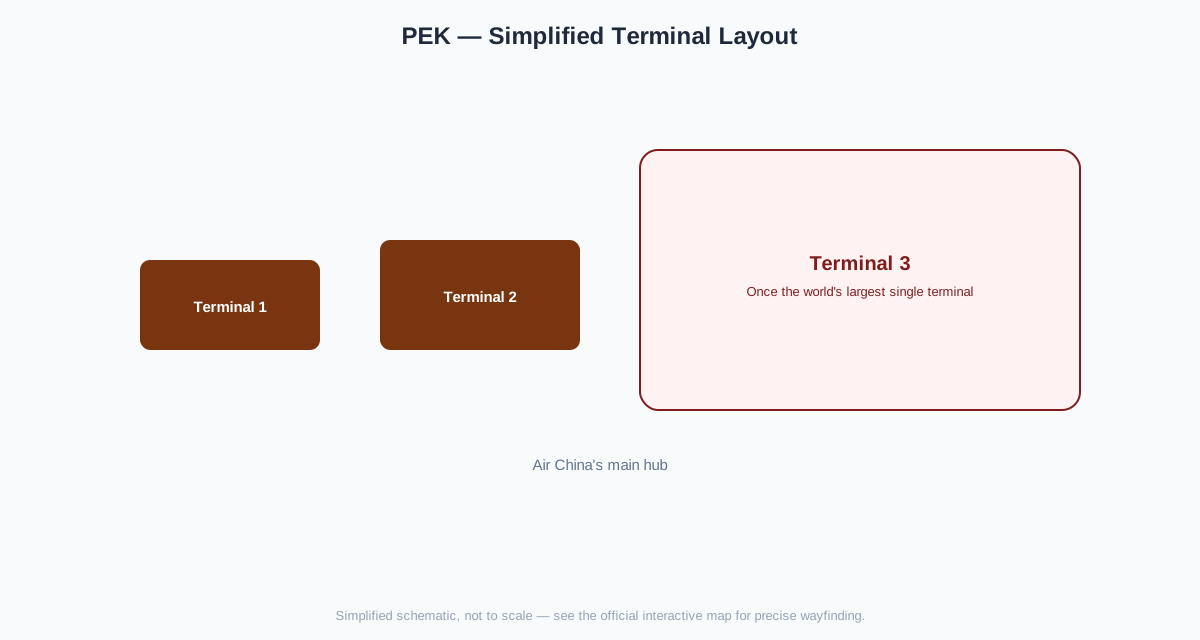
This is a simplified layout to help you get oriented — for real-time, gate-by-gate wayfinding, use Beijing Capital Airport’s official resources.
Useful Links
- Official airport site (Beijing Capital International Airport) — terminal info, services, live flight status.
- Beijing Airport Express — subway fares and schedules.
Long Layover Tips
- With 6+ hours and eligibility for the 144-hour visa-free transit policy (verify your nationality qualifies and bring your onward ticket), central Beijing is reachable via the Airport Express in about 20–30 minutes.
- If staying airside, Terminal 3 has by far the best mix of lounges, dining, and shopping for a long international wait — its sheer scale means there’s genuinely a lot to explore without leaving security.
- Given Terminal 3’s size, if your connection is tight, don’t underestimate the walk (or shuttle ride) between distant gates — build in real buffer time.
Related airports
 BKK
BKK Bangkok Suvarnabhumi Airport: A Golden Mural the Size of a Terminal Hall
Bangkok, Thailand
Suvarnabhumi's main hall is dominated by a massive golden mythological mural. Transport into Bangkok, security, and lounges.
 DEL
DEL Delhi Airport: You Need Your Ticket Just to Walk In
Delhi, India
You need a valid ticket just to enter Delhi's Indira Gandhi terminal building. Transport into the city, security wait times, parking, and lounges.
 DPS
DPS Bali's Ngurah Rai Airport: Landing Over the Ocean on a Runway Built Into the Sea
Denpasar, Indonesia
Bali's airport runway was extended out into the ocean on reclaimed land, creating one of the world's most scenic approaches. Transport, security, dining.