Cancún Airport: Gateway to a Resort City That Didn't Exist Before 1970
Cancún International Airport (CUN) — Cancún, Mexico
Published August 24, 2026

CUN
IATA code
30.4M (2024)
Passengers
3 (T2, T3, T4)
Terminals
20 km
To city center
Only here
Gateway to a resort city that didn't exist before 1970
Cancún itself was deliberately planned and built from scratch starting in the early 1970s, when Mexican government planners identified an almost uninhabited stretch of Caribbean coastline and sandbar as ideal for a purpose-built tourist destination. What began as a development project is now one of the busiest airports in Latin America — a rare case of an entire resort city, and the airport serving it, engineered into existence within a single generation.
Getting there, at a glance
Colectivo (shared van)
~200–300 MXN
~30–45 min
Shared shuttle, drops at multiple hotels
ADO bus
~90–150 MXN
~30–40 min
Direct to downtown or the Hotel Zone
Official airport taxi
~600–900 MXN
~20–25 min
Fixed-rate booth inside the terminal
✈️ What kind of flight are you taking?
Arrive at the airport
2 hours
Typical security wait
15–20 min
Peak-hour wait
25–35 min
Amenities, at a glance
Wifi
Free, limited session
Lounges
Centurion Lounge + Priority Pass
Duty-Free
Tequila, Cuban cigars
Dining
Yucatecan and Mexican cuisine
Hotel
None on-site; resorts are 30–45 min away
Book & Save
These are affiliate links — we may earn a commission if you book through them, at no extra cost to you.
Cancún International Airport (IATA: CUN) is one of the busiest airports in Latin America and a key focus city for both Viva Aerobus and Volaris. CUN handled 30.4 million passengers in 2024, a second straight year of decline from its 2022 record of 32.7 million — domestic traffic fell 13.6% and international traffic 3.5%, though it remains one of the busiest airports in the Americas. It sits about 20 km south of the Hotel Zone, on Mexico’s Caribbean coast.
Overview
CUN operates three active terminals and serves a city with a genuinely unusual origin story: Cancún was deliberately planned and built from scratch starting in the early 1970s, when Mexican government planners identified an almost uninhabited stretch of coastline and sandbar as ideal for a purpose-built resort. What’s now one of the busiest airports in Latin America didn’t exist in any meaningful form barely five decades ago — a striking example of a destination engineered into being within a single generation.
Terminals
- Terminal 2: Handles mostly domestic Mexican carriers.
- Terminal 3: The largest and busiest, handling the bulk of international traffic.
- Terminal 4: Handles additional international and charter traffic during peak tourist season.
Airlines
Viva Aerobus and Volaris, two of Mexico’s major low-cost carriers, both treat CUN as a key focus city, running extensive domestic networks alongside international routes to the United States, Canada, and beyond. Given Cancún’s status as a top global beach destination, the airport also draws a wide range of international carriers serving it directly, especially during North American winter and spring break seasons.
Getting There
- Colectivo (shared van): Around 200–300 MXN, a shared shuttle dropping at multiple hotels along the way, about 30–45 minutes.
- ADO bus: Around 90–150 MXN, direct to downtown Cancún or the Hotel Zone, about 30–40 minutes.
- Official airport taxi: Around 600–900 MXN from the fixed-rate booth inside the terminal, about 20–25 minutes — notably pricier than ride-hailing options outside the airport perimeter.
Prices above are approximate and subject to change — always check current fares at the ADO or colectivo counters inside the terminal.
Security and Passport Control Wait Times
- Domestic flights: Security only. Typically 15–20 minutes during off-peak hours, up to 25–35 minutes during busy periods.
- International flights: Security plus passport control. Typically 25–35 minutes during off-peak hours, up to 40–60 minutes during peak tourist-season departure banks.
- CUN sees strong seasonal variation tied to North American winter and spring break travel — expect longer waits during those windows.
Parking
All three terminals have adjacent short- and long-stay parking, with clear signage.
Wifi
Free wifi is available in the terminal with a limited free session.
Best Times to Arrive
- Domestic flights: Arrive 2 hours before departure.
- International flights: Arrive 3 hours before departure, especially during peak winter and spring break tourist season.
- Given CUN’s heavy seasonal tourist traffic, building in extra buffer time during North American school holidays is worth the caution.
Where to Eat
CUN has a good selection of Yucatecan and broader Mexican cuisine alongside international chains, spread across its terminals.
Airport Hotel
CUN doesn’t have a hotel at the airport itself. Nearly everyone here is headed to a resort in the Hotel Zone, 30–45 minutes away by colectivo or ADO bus — that’s genuinely the norm rather than the exception at an airport built to serve a purpose-made resort city.
Lounges
- The American Express Centurion Lounge is available for eligible cardholders.
- Several Priority Pass-affiliated lounges are also available.
Duty-Free Shopping
CUN’s duty-free area includes Mexican tequila and Cuban cigars — notably more accessible here than in many other countries — alongside the usual international fashion, cosmetics, and electronics brands.
Airport Map
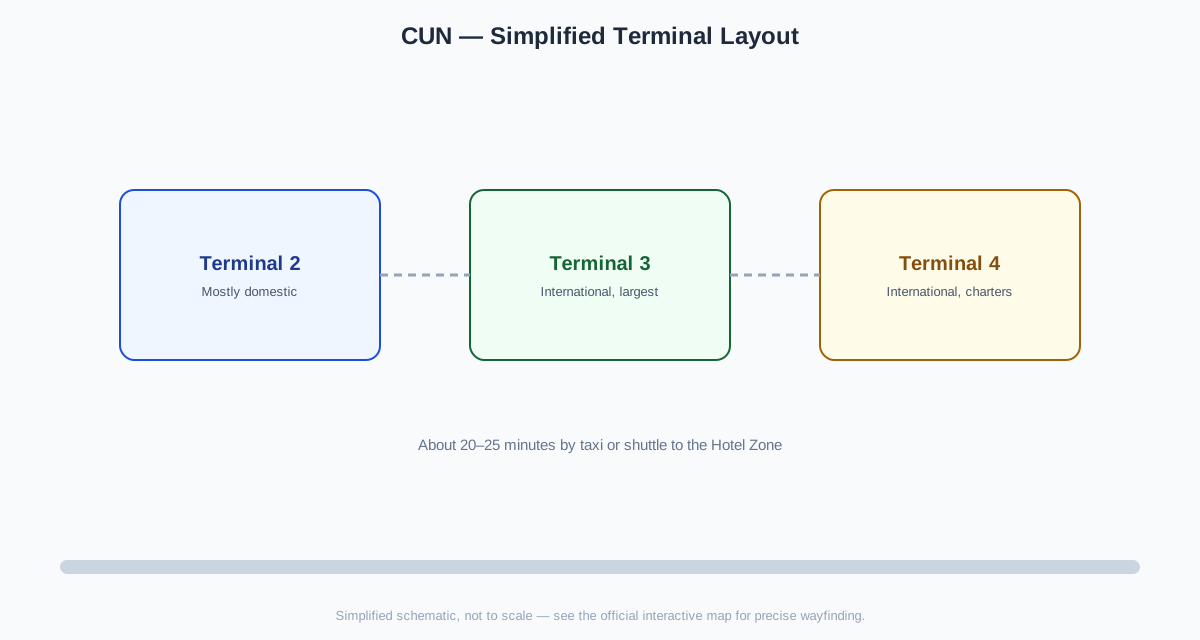
This is a simplified layout for orientation — for precise gate-by-gate navigation, use the official Cancún Airport resources.
Useful Links
- Official airport website (Cancún International Airport) — terminal information, services, live flight status.
- ADO — bus fares and schedules.
Layover Tips
- With 4 hours or more and a visa situation that allows entry, the Hotel Zone’s beaches are reachable via ADO bus or colectivo in about 30–40 minutes — though most visitors treat Cancún as a destination rather than a connecting point.
- If staying airside, CUN’s duty-free tequila and cigar selection is genuinely notable compared to most international airports.
- Given Cancún’s origin as a purpose-built resort, nearly everything about the destination — including the airport itself — reflects deliberate large-scale tourism planning rather than organic growth around an older city.
Related airports
 ATL
ATL Atlanta Hartsfield-Jackson Airport: The World's Busiest Airport Train
Atlanta, United States
Atlanta's Hartsfield-Jackson runs the world's busiest airport train. Transport into the city, security wait times, parking, wifi, and lounges covered.
 BOG
BOG Bogotá El Dorado Airport: One of the World's Highest Major Airports
Bogotá, Colombia
Bogotá's El Dorado sits nearly 2,550 meters above sea level. Transport into the city, security wait times, parking, and lounges.
 BSB
BSB Brasília Airport: Landing in a City Shaped Like an Airplane
Brasília, Brazil
Brasília's airport serves a UNESCO-listed modernist capital deliberately laid out in the shape of an airplane. Transport, security, and lounges.