Barcelona-El Prat Airport: Grab a Window Seat for the Mediterranean Approach
Josep Tarradellas Barcelona-El Prat Airport (BCN) — Barcelona, Spain
Published July 20, 2026 · Updated August 9, 2026
BCN
IATA code
55M (2024)
Passengers
2
Terminals
12 km / 7 mi
To city center
Only here
Grab a window seat on arrival
T1's departures hall has floor-to-ceiling windows facing both the Mediterranean and the Collserola hills — one of the more scenic terminal views in Europe, especially at sunset.
Getting there, at a glance
Aerobús (A1/A2)
€7.45 one-way
~35 min
24/7 to Pl. Catalunya
Rodalies R2 Nord
€4.60 single
~20–25 min
T2 only, shuttle from T1
Taxi
€35–€45
~25–40 min
+€4.60 airport supplement
✈️ What kind of flight are you taking?
Arrive at the airport
90 minutes
Typical security wait
15–25 min
Peak-hour wait
40–45 min
Amenities, at a glance
Wifi
Time-limited free session
Lounges
Sala VIP + Priority Pass
Duty-Free
Cava, gourmet, fashion
Dining
Catalan food, best in T1
Hotel
Sleep&Fly, inside Terminal 1
Book & Save
These are affiliate links — we may earn a commission if you book through them, at no extra cost to you.
Barcelona-El Prat (IATA: BCN) is Spain’s second-busiest airport and the main base for low-cost carrier Vueling. Located about 12 km southwest of the city center, it’s a common gateway for both leisure travelers heading to the Mediterranean coast and business travelers visiting the city.
Overview
BCN has two main passenger terminals — T1 and T2 — that are not within walking distance of each other. A free shuttle bus connects them in about 10 minutes. Always double-check your terminal before heading out, especially if you’re connecting between a legacy carrier and a low-cost one. Aena, the airport operator, confirmed 55,034,955 passengers for 2024, a 10.3% increase on 2023 and a new all-time record that reached the airport’s stated maximum capacity.
Terminals
- Terminal 1 (T1): The larger, newer terminal, handling most full-service airlines, including Vueling, Iberia, and most long-haul international flights.
- Terminal 2 (T2, split into 2A/2B/2C): Older terminal used mainly by low-cost carriers such as Ryanair and easyJet.
Airlines
Vueling is BCN’s dominant carrier, followed by Ryanair, easyJet, Iberia, and a wide range of European and international airlines. BCN has strong connectivity to the rest of Europe and a growing number of long-haul routes to North America and Asia.
How to Get There
- Aerobús (A1/A2): €7.45 one-way (€12.85 return, valid 90 days) — direct express bus to Plaça Catalunya, about 35 minutes, running 24/7 with a stop at both T1 (line A1) and T2 (line A2), every 5–20 minutes depending on the time of day.
- Rodalies train (R2 Nord line): €4.60 single fare (or €12.15 for a 10-trip T-casual card, reusable around the city). About 20–25 minutes to Barcelona-Sants and Passeig de Gràcia. It only stops at T2 — from T1 you need the free inter-terminal shuttle first, so budget extra time.
- Metro (L9 Sud): Standard metro single fare, links both terminals to the city — cheaper than the Aerobús but slower (around 30–45 minutes to central stops), useful if your hotel sits right on the L9/L10 line.
- Taxi: €35–€45 on average to the city center (minimum airport-origin charge around €21, plus a €4.60 airport supplement), roughly 25–40 minutes depending on traffic.
Prices above are indicative and can change — always check the operator’s site for the current fare: Aerobús, Rodalies.
Getting Through Security and Passport Control
- Schengen flights: Security only. Typically 15–25 minutes off-peak, up to 40–45 minutes during the low-cost carrier departure banks (early morning and late afternoon), which are concentrated in T2.
- Non-Schengen (international) flights: Security plus passport control. Typically 25–45 minutes off-peak, up to 60–75 minutes during peak summer departure waves.
- T1 checkpoints are generally faster and less crowded than T2’s, which absorbs most of the low-cost traffic.
Parking
Both terminals have on-site short- and long-stay car parks. As with most large airports, pre-booking online is cheaper than paying the walk-up rate, and off-airport lots offer further savings for stays of several days.
Wifi
Free wifi is available across both terminals with a time-limited free session. For longer or more reliable connectivity, an eSIM data plan is recommended, particularly if you need video calls during a layover.
Best Times to Arrive
- Domestic/Schengen flights: 90 minutes is usually sufficient; allow 2 hours if departing from T2 during an early-morning or late-afternoon low-cost bank.
- International flights: Arrive 3 hours ahead — security lines at T2 can be slow during peak departure banks.
- If you’re connecting between T1 and T2 (or need the shuttle to reach the R2 Nord train from T1), add 20–30 minutes to whichever estimate above applies.
- Summer weekends see the heaviest traffic due to leisure travel to the Costa Brava and Balearic Islands.
Where to Eat
T1 offers a broader range of sit-down restaurants and Catalan food options post-security, while T2 leans toward quick-service cafes and fast food, in line with its low-cost carrier passenger base. Both terminals have Spanish coffee chains and tapas bars. Named options in T1 include Alas by Hermanos Torres — an open-kitchen concept from the celebrity chef brothers — and Como, serving fresh regional Spanish dishes.
Airport Hotel
Sleep&Fly sits inside Terminal 1’s business center area — a compact hotel built for short stays between flights rather than a full-service resort, with 24-hour reception. It doesn’t have its own restaurant, so pair a stay there with T1’s sit-down options just outside.
Lounges
- Sala VIP Barcelona lounges are available in both T1 and T2, accessible via business class tickets, airline status, or paid day-pass.
- Priority Pass-affiliated lounges are also present, mainly concentrated in T1.
Duty-Free Shopping
T1’s duty-free area is significantly larger than T2’s, with Spanish and Catalan gourmet products, cava, fashion, and perfume. If departing from T2, expect a more limited selection focused on essentials and souvenirs.
Airport Map
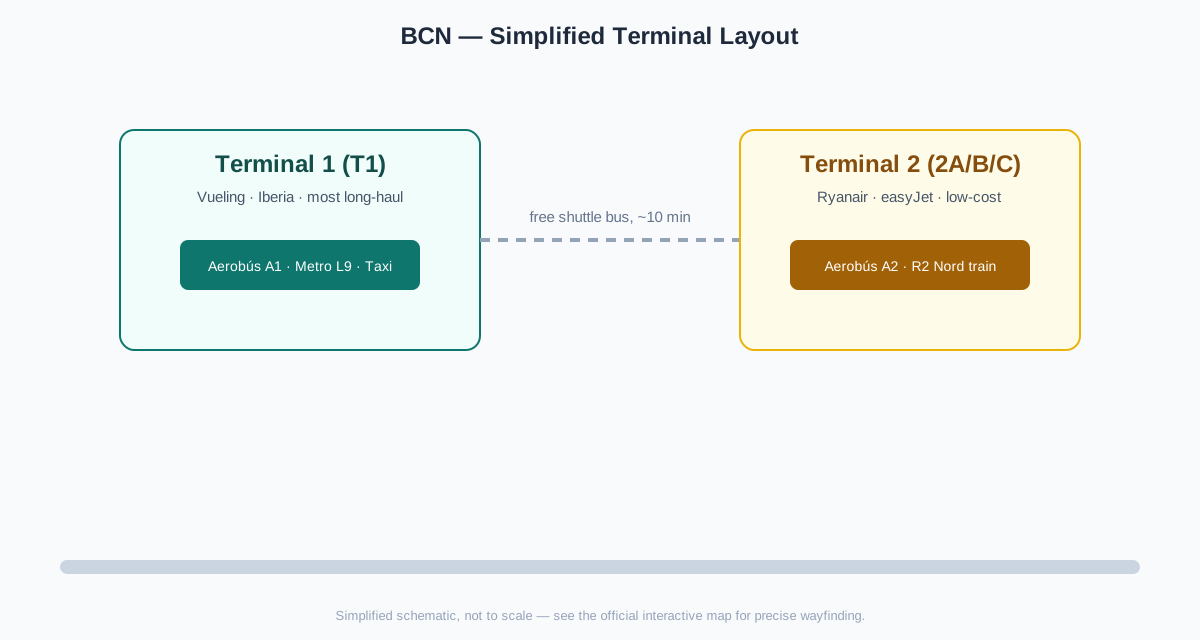
This is a simplified layout to help you get oriented — for real-time, gate-by-gate wayfinding, use Aena’s official interactive map.
Useful Links
- Official airport page (Aena) — terminal info, services, live flight status.
- Interactive terminal map (Aena) — search shops, gates, and get walking directions.
- Aerobús — official site — timetables and tickets.
- Rodalies de Catalunya — R2 Nord timetables and fares.
- TMB — Barcelona Metro — L9 Sud fares and route planner.
Long Layover Tips
- With a layover of 5+ hours and an EU/Schengen-eligible passport, a quick trip into central Barcelona is feasible via Aerobús — but factor in security re-entry time on the way back.
- If connecting between T1 and T2, allow at least 45-60 minutes for the shuttle bus plus security if you need to re-clear it.
- T1 has more comfortable seating areas and better rest options for a long airside wait than T2.
Related airports
 ATH
ATH Athens Airport: A Real Archaeological Museum Built From What They Dug Up
Athens, Greece
Athens Airport has a genuine archaeological museum showing artifacts unearthed during its own construction. Transport, security, and lounges.
 AMS
AMS Amsterdam Schiphol Airport: Home to a Museum Inside the Terminal
Amsterdam, Netherlands
Schiphol has its own art museum annex inside the terminal. Here's how to get into Amsterdam, clear security fast, and make the most of a layover.
 CPH
CPH Copenhagen Airport: 14 Minutes From Touchdown to the Center of a Capital City
Copenhagen, Denmark
Copenhagen Airport is one of Europe's closest major airports to a capital city center. Transport, security wait times, and lounges.