Osaka Kansai Airport: Built Entirely on a Man-Made Island That's Slowly Sinking
Kansai International Airport (KIX) — Osaka, Japan
Published August 21, 2026
KIX
IATA code
30.6M (2024)
Passengers
2 (T1, T2)
Terminals
50 km
To city center
Only here
Built entirely on a man-made island that's slowly sinking
Kansai International Airport was constructed from scratch on a massive artificial island in Osaka Bay — one of the largest and most ambitious airport engineering projects ever undertaken. The island has been gradually sinking since it opened, a genuinely ongoing engineering challenge that has required continuous countermeasures to keep the airport operational decades later.
Getting there, at a glance
JR Haruka Express
1,200–2,900 JPY
~45–70 min
Direct to central Osaka
Nankai Line
930–1,450 JPY
~45–60 min
Alternative rail connection
Taxi
15,000–20,000 JPY
~60–70 min
Metered
✈️ What kind of flight are you taking?
Arrive at the airport
2 hours
Typical security wait
15–20 min
Peak-hour wait
25–35 min
Amenities, at a glance
Wifi
Free, unlimited
Lounges
JAL Sakura Lounge + Priority Pass
Duty-Free
Japanese sake, matcha sweets
Dining
Japanese cuisine, Osaka street food
Hotel
Hotel Nikko, covered walkway to T1
Book & Save
These are affiliate links — we may earn a commission if you book through them, at no extra cost to you.
Kansai International Airport (IATA: KIX) is one of Osaka’s two major airports and a hub for both Japan Airlines and Peach Aviation, with more than 25 million passengers a year. It sits about 50 km southwest of central Osaka, built entirely on an artificial island in Osaka Bay.
Overview
KIX operates two terminals and holds a genuinely remarkable engineering distinction: the entire airport sits on a man-made island constructed from scratch specifically to house it, one of the most ambitious civil engineering projects ever undertaken. The island has been gradually sinking since opening — a real, ongoing challenge that has required continuous engineering countermeasures to keep the airport functioning. KIX served over 30.6 million passengers in 2024, part of the sustained inbound-tourism surge that has pushed Terminal 1’s renovation to raise annual capacity to 40 million.
Terminals
- Terminal 1: The main terminal, handling most international carriers including Japan Airlines’ core operations.
- Terminal 2: Handles low-cost carriers including Peach Aviation, connected to Terminal 1 by shuttle.
Airlines
Japan Airlines operates significant international and domestic services from KIX, alongside Peach Aviation, one of Japan’s major low-cost carriers, which uses KIX as a key base. That combination gives KIX strong connectivity for both full-service and budget travel across Japan and internationally.
Getting There
- JR Haruka Express: 1,200–2,900 JPY depending on reserved/non-reserved seating, a direct service to central Osaka in about 45–70 minutes.
- Nankai Line: 930–1,450 JPY, an alternative rail connection, about 45–60 minutes.
- Taxi: Metered, typically 15,000–20,000 JPY, about 60–70 minutes given the distance.
Prices above are approximate and subject to change — always check current fares with JR West or Nankai Railway.
Security and Passport Control Wait Times
- Regional flights: Security plus immigration for most nearby Asian routes. Typically 15–20 minutes during off-peak hours, up to 25–35 minutes during busy periods.
- International flights: Security plus passport control. Typically 20–30 minutes during off-peak hours, up to 35–50 minutes during peak international departure banks.
- KIX generally processes passengers efficiently, reflecting Japan’s broader reputation for well-organized airport operations.
Parking
Both terminals have extensive short- and long-stay parking, with clear signage.
Wifi
Free, unlimited wifi is available throughout the airport with no time limit.
Best Times to Arrive
- Regional flights: Arrive 2 hours before departure.
- International flights: Arrive 3 hours before departure, especially during peak departure periods.
- Given the airport’s distance from central Osaka, factor in real transfer time on top of terminal processing — the trip itself takes 45 minutes or more even by the fastest train.
Where to Eat
KIX has an excellent selection of Japanese cuisine, including genuine Osaka-style street food, alongside international chains, spread across both terminals. At the Hotel Nikko, four restaurants cover the range: Hanazato for Japanese cuisine, Icho for teppanyaki grill, Toh-Lee for Chinese, and The Brasserie for Japanese-Western fusion, plus Jet Stream for grilled dishes with a runway view.
Airport Hotel
The Hotel Nikko Kansai Airport connects to Terminal 1 via a covered walkway, about a 5-minute walk that stays indoors the whole way. With four distinct restaurants on-site, it’s a genuinely well-equipped choice for a long layover or an early departure.
Lounges
- The JAL Sakura Lounge is available for eligible business class passengers, elite status holders, or paid access.
- Several Priority Pass-affiliated lounges are also available.
Duty-Free Shopping
KIX’s duty-free area includes genuinely Japanese specialties — sake and matcha sweets — alongside the usual international fashion, cosmetics, and electronics brands.
Airport Map
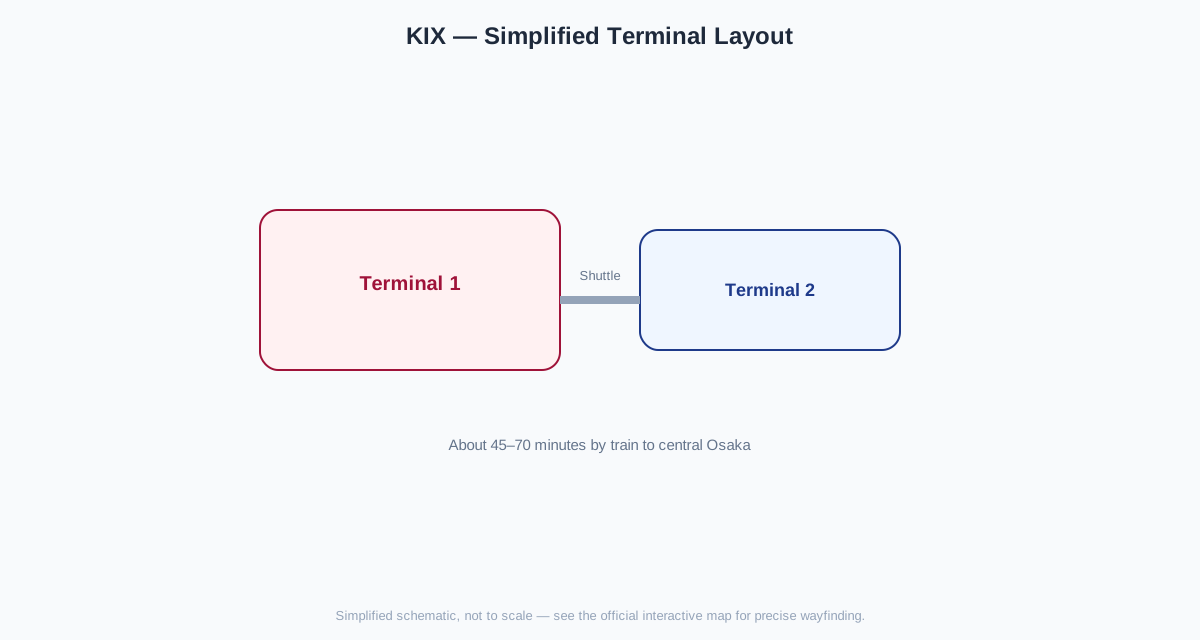
This is a simplified layout for orientation — for precise gate-by-gate navigation, use the official Kansai Airport resources.
Useful Links
- Official airport website (Kansai International Airport) — terminal information, services, live flight status.
- JR West — Haruka Express — fares and schedules.
Layover Tips
- With 5 hours or more and a visa situation that allows entry, central Osaka is reachable via the JR Haruka Express in about 45–70 minutes.
- If staying airside, take a moment to appreciate the sheer engineering scale of the terminal building — it’s genuinely one of the most ambitious airport construction projects in aviation history.
- Given KIX’s distance from Osaka, weigh carefully whether a city visit is worth it on a shorter connection — the round-trip transfer alone can consume a significant chunk of a short layover.
Related airports
 BKK
BKK Bangkok Suvarnabhumi Airport: A Golden Mural the Size of a Terminal Hall
Bangkok, Thailand
Suvarnabhumi's main hall is dominated by a massive golden mythological mural. Transport into Bangkok, security, and lounges.
 PEK
PEK Beijing Capital Airport: Once the World's Largest Airport Terminal
Beijing, China
Beijing Capital's Terminal 3 was once the largest airport terminal in the world. Transport into the city, security wait times, and lounges.
 DEL
DEL Delhi Airport: You Need Your Ticket Just to Walk In
Delhi, India
You need a valid ticket just to enter Delhi's Indira Gandhi terminal building. Transport into the city, security wait times, parking, and lounges.